


Introduction
In an era dominated by high-octane video games, endless scrolling on social media, and immersive virtual realities, a simple web-based puzzle called Wordle has captured the hearts and minds of millions. Launched quietly in 2021, Wordle offers players six chances to guess a five-letter word, providing color-coded feedback that turns each attempt into a thrilling deductive challenge. Its minimalist design—no ads, no subscriptions required initially, and just one puzzle per day—stands in stark contrast to the overstimulated digital landscape. Yet, this simplicity is precisely what propelled it to viral fame, making it a cultural staple that continues to evolve even in 2025. This article explores Wordle’s origins, mechanics, meteoric rise, cultural footprint, and ongoing legacy, shedding light on why a game about guessing words feels so profoundly satisfying.
Origins and Development: From Prototype to Pandemic Pastime
Wordle’s story begins with Josh Wardle, a Welsh software engineer whose surname serendipitously inspired the game’s name.

Wordle creator Josh Wardle feels ‘relief’ as he sells hit puzzle …
The project languished until the COVID-19 pandemic struck. Confined indoors, Wardle and Shah found solace in word games like The New York Times’ Spelling Bee and crossword puzzles. This reignited Wardle’s passion, leading him to revive and polish Wordle for personal use in January 2021. He shared it with family and friends, who quickly became hooked. By October 2021, Wardle made it publicly available online, free of charge. The game’s lack of monetization was intentional; Wardle wanted to create something pure, untainted by ads or data harvesting.
Gameplay Mechanics: Simplicity Meets Strategy
At its core, Wordle is elegantly straightforward. Players input a five-letter word, and the game responds with a color-coded grid: green for letters in the correct position, yellow for correct letters in the wrong spot, and gray for letters not in the word at all.

Why Wordle Works, According to Desmos Lesson Developers
What makes Wordle addictive is its psychological hooks. The limited attempts create tension, while the daily reset builds anticipation. Psychologists note that the game’s structure taps into human desires for mastery and social connection. Sharing results via emoji grids—without spoiling the word—allows players to boast subtly or commiserate, amplifying its virality. Unlike endless games that can lead to burnout, Wordle’s scarcity principle ensures it remains a brief, rewarding ritual.
The Meteoric Rise to Popularity
Wordle’s ascent was nothing short of explosive. From just 90 players on November 1, 2021, it ballooned to over 300,000 by early January 2022, and millions soon after. The turning point was Wardle’s addition of the shareable emoji grid, which flooded social media platforms like Twitter (now X) with cryptic posts. Media outlets dubbed it the “pandemic puzzle,” attributing its success to providing a low-stakes distraction during uncertain times.
By 2022, Wordle had become a global phenomenon. It topped Google’s search trends worldwide and in the US, sparking curiosity in word definitions and even influencing language learning. Celebrities, politicians, and even Pope Leo XIV in 2025 were reported as fans, highlighting its universal appeal. The game’s popularity also spawned memes, merchandise, and academic discussions on gamification and digital culture.
Cultural Impact: Beyond the Grid
Wordle’s influence extends far beyond gameplay. It has reshaped how we think about digital entertainment, proving that less can be more. In a world of algorithm-driven content, Wordle’s ad-free model challenged the status quo, inspiring debates on ethical game design. It fostered community, with players forming online groups to discuss strategies and share triumphs. Health experts praised it for boosting cognitive skills like vocabulary and problem-solving, while some studies linked daily play to improved mental well-being.
On the flip side, its competitiveness revealed insecurities; sharing scores became a subtle brag, sometimes straining relationships. Linguistically, it highlighted English’s quirks, prompting interest in etymology and regional spellings. Brands jumped on the bandwagon, creating Wordle-inspired ads, while educators incorporated it into lessons on probability and language arts. In 2023 alone, the game was played 4.8 billion times, cementing its place in pop culture.
Acquisition by The New York Times: A New Chapter
In January 2022, The New York Times acquired Wordle for a low seven-figure sum, integrating it into their Games portfolio to attract digital subscribers. Wardle cited overwhelming attention and clone proliferation as reasons for the sale. The transition wasn’t seamless—some players lost streaks during migration—but NYT preserved its free access while adding features like stat tracking and WordleBot, an AI analyzer for guesses.
Under NYT, the game evolved responsibly. Offensive words were removed, and editor Tracy Bennett began curating puzzles in 2022, occasionally tying them to holidays or events. By 2025, player numbers stabilized at half the 2022 peak, but engagement in NYT’s ecosystem surged, proving the acquisition’s success.
Variants and Spin-Offs: The Wordle Universe Expands
Wordle’s success birthed a legion of variants, each twisting the formula for new thrills.
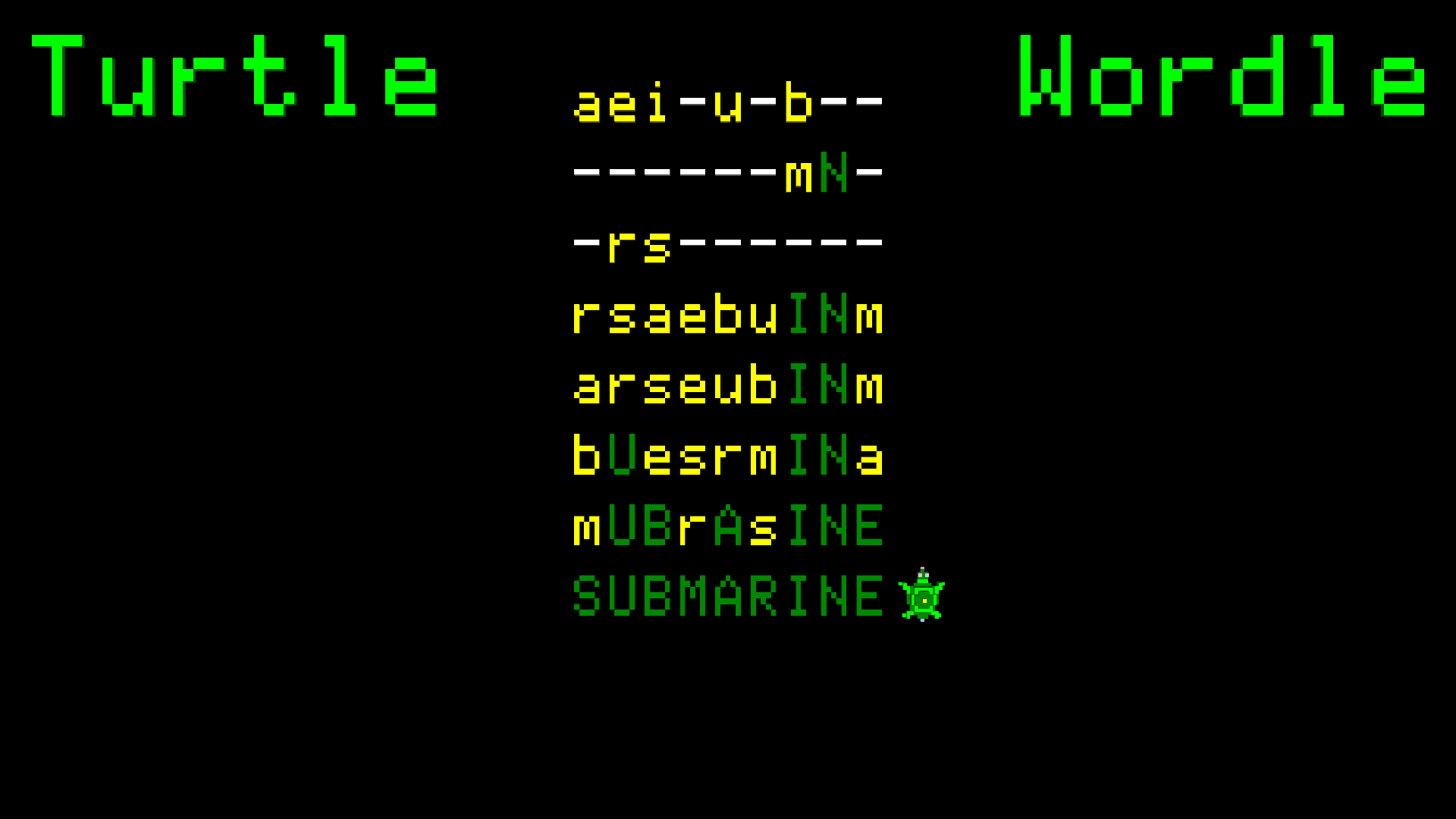
Turtle Wordle: A Clone of Wordle in 60 Lines of Logo – turtleSpaces
Absurdle turns adversarial, changing the word to prolong the game; Quordle challenges players with four puzzles simultaneously; and Heardle applies the mechanic to song clips, later acquired by Spotify. Themed versions abound: Worldle for geography, Poeltl for NBA players, and even Sweardle for profanity.
By 2025, over 399 spin-offs exist, including multilingual adaptations in 158 languages through the “Wordles of the World” project. Some, like Brazilian Termo, achieved massive local success. NYT has pursued legal action against clones, such as suing Worldle in 2024 for trademark infringement. These variants keep the spirit alive, extending Wordle’s influence into niches like music, sports, and education.
Recent Updates and Challenges in 2025
As of December 2025, Wordle remains vibrant. The puzzle for December 30, #1655, continues the tradition, with hints and answers available daily. This year saw some of the toughest words, like “BONGO” as the biggest streak-breaker and “KRILL” stumping nearly 20% of players. NYT released rankings of the hardest puzzles, including Wordle and Connections, highlighting evolving difficulty to retain engagement.
Updates include enhanced AI tools and community features, but challenges persist: maintaining freshness amid variants and addressing solver fatigue. Yet, Wordle’s core endures, a testament to thoughtful design.
Conclusion
Wordle isn’t just a game; it’s a cultural mirror reflecting our need for connection, challenge, and simplicity in a complex world. From Wardle’s basement prototype to a NYT cornerstone, it has democratized puzzling, inspiring creativity and community. As we approach 2026, Wordle’s legacy lies in proving that in the digital age, sometimes the best innovations are the ones that slow us down. Whether you’re a daily devotee or occasional player, Wordle reminds us that words—and the games we play with them—have timeless power.
